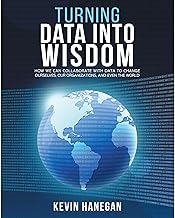
Turning Data Into Wisdom โ€” book cover
Published ยท 2020

How we can collaborate with data to change ourselves, our organizations, and even the world.

A practical guide to data-informed decision-making, the science of how the brain decides, and the human skills that turn data into wisdom.
AuthorKevin Hanegan Year2020 FormatPaperback & eBook ISBN978-0-578-63987-1
Buy on Amazon
The thesis

Data is a puzzle. Wisdom comes from learning to see all the pieces.

Most data and analytics initiatives focus on the technology. The dashboards, the platforms, the tooling. Turning Data Into Wisdom takes a different starting point. It treats data-informed decision-making as a human process, one that draws on analytics, psychology, anthropology, and enterprise thinking together.

The book introduces a six-phase methodology for making decisions with data, walks through the science of how the brain actually processes information, and gives readers a working toolkit of frameworks and models they can pull from when a decision lands on their desk.

It is a book for anyone who needs to make decisions at any level of an organization. Not just data professionals. The process is iterative, not linear, and different decisions call for different tools. Think of the book as a tool kit you can pull from rather than a script you follow.

Underneath the methodology runs a simple conviction. Investments in data strategy and analytics will be useless, and can even be harmful, unless individuals and organizations also build the human skills to provide the right context for the data. Wisdom is what comes from doing both.

What's inside

A methodology, the science of how the brain decides, and a working toolkit.

The six-phase decision process

Ask, Acquire, Analytics, Apply, Announce, Assess. The book walks through each phase with worked examples, showing how to turn business questions into analytical questions, find and trust the right data, run the right kind of analysis, apply judgment honestly, communicate the decision well, and then assess whether it worked.

The science of how the brain decides

An entire chapter on what is actually happening when we make a decision. Heuristics. Mental models. System 1 versus System 2 thinking. Cognitive bias categories: pattern-recognition, action-oriented, social, stability. Plus groupthink and the impact of organizational culture on the decisions individuals make.

A toolkit of frameworks and models

Logic Model, OODA Loop, Behavior Engineering Model, Vroom-Yetton-Jago, Pugh Matrix, Force Field Analysis, Zig-Zag Process Model, Ladder of Inference, Theory of Constraints, Competing Values Framework. Each one explained, illustrated with an example, and matched to the phase of decision-making it best supports.

From descriptive to prescriptive analytics

A clear walk through the four analytics modes: descriptive (what happened), diagnostic (why it happened), predictive (what may happen), and prescriptive (what should we do). Practical examples drawn from retail, healthcare, soup sales, and personal life.

Mitigating bias at three levels

Concrete strategies for reducing bias in your own thinking, in group decisions, and in the structures of an organization. Including premortems, designated devil's advocates, structured dissent, and process-level redesign.

Five real case studies

Working examples that show the full methodology applied end-to-end. A personal life decision. Declining revenue. Missing sales quotas. Declining soup sales. Lower-than-planned profits. Plus templates and job aides for each tool, ready to take into your next decision.

From the introduction

As I got older, I studied math and statistics in school and was taught there is only one answer to a given problem. Whether it was a calculation, a truth value of a statement for a theorem, or something else, there was always only one right answer. Everything was black and white.

Eventually, I started diving more into data literacy and had a realization. A data point, a piece of evidence, or an observation. They all actually have many sides and are all parts of a puzzle. There is a story there waiting to be unlocked.

When you start to combine data together, you are starting to put the pieces of the puzzle together. Then, when you add in your experiences and beliefs to it, along with the experiences and beliefs of others, the data starts to come to life and tell you a story. A story that can give you great wisdom and insights. This is one reason why decision-making should celebrate diversity and inclusion and be a team sport. You are able to see multiple sides of the data and what its story is.

From the introduction
Related

Continue with related work.

Want Kevin to speak about the ideas in this book at your event or organization?

Many of his keynotes โ€” particularly Data Literacy for Modern Organizations and The Judgment Gap โ€” draw directly from this book.

Start a conversation All books